The Premise
I am an artist whose practice was made possible by AI. In the past 18 months I've built programmable light sculptures, called Lightboxes, and the light design software to program them, called Nuance. AI was involved every step of building, from the beginning of the story — creating a simple phone-based breath tracker and using the signal to control lights — all the way to the little details of the UI in Nuance, which is now optimized, professional software that other artists are starting to use.
This art practice lives in a new creative territory that only becomes accessible when you can try new things as fast and robustly as AI tools now enable us to. The accumulation of small trials is new to technical art; there's a phase-change in the creative process when you can tinker at the speed of AI. You get the delight of following creative impulses and seeing where they lead you.
The next phase of the project involves creating large-scale works — sculptures 10–12 feet tall, installed in galleries and public spaces, with live performances built around and in response to the lights. This next phase will also introduce Nuance into a wider array of professional creative settings (theater-making, music performances, and more). I'm proposing an Anthropic art residency to continue developing this work, as a showcase of the kind of creativity and cultural contribution that can occur using AI.
The Work
Lightboxes
The Lightbox series, which I develop under the moniker AND THE SUN, leverages a core psycho-perceptual phenomenon: namely, that slow-moving, diffuse, warm-white light is naturally calming and contemplative, and simultaneously facilitates alertness — much like a campfire. The Lightbox format combines a variety of subtle sculptural details to turn this phenomenon into a canvas.
Lightboxes introduce a sense of peace, delight, and possibility. The more time you spend with a Lightbox, and the more ways you see the light composed, the more you appreciate the expressive possibility of such a simple format — and that sense of possibility, too, becomes part of the art.
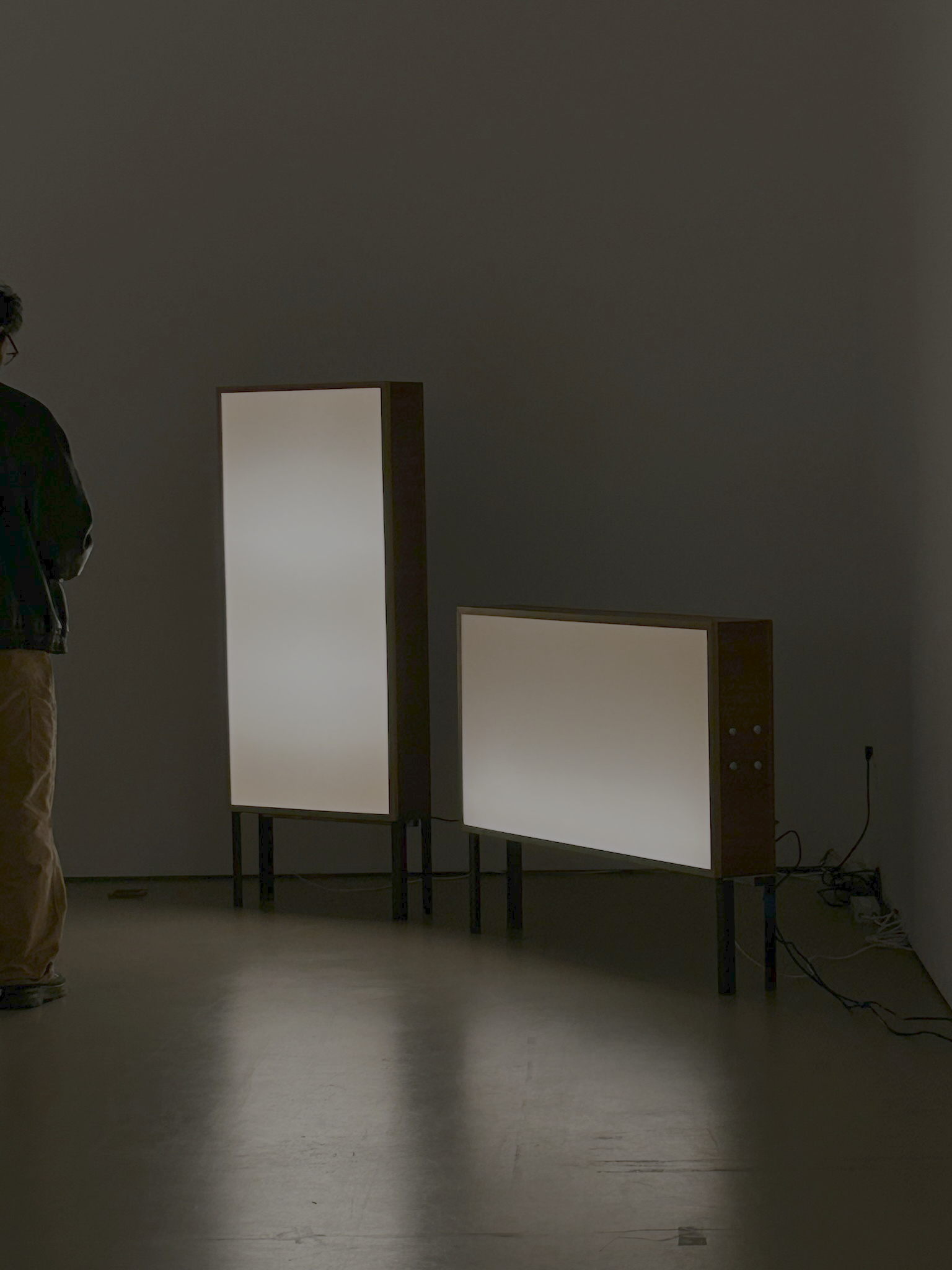
Lightboxes on display at event in SF.
The Lightboxes are a continuation of several lineages of 20th century art. Most directly, they are an extension of the Light and Space movement's close perceptual study of light. Artists like James Turrell with his famous Skyspaces — a series in which a hole is cut in a ceiling to frame the sky, and LEDs are used to light the frame to create a continuously changing set of perceptual effects — and like Robert Irwin, who performed a light and form combinatorics, placing simple light sources in arrangements that were at once ironic and instructive.
The Lightboxes also inherit from Minimalism. Donald Judd took rectangular form and varied it over and over, finding just the right formal game to play. The Lightbox practice — which has, so far, stuck to simple rectangular forms — has been inspired by Judd's understanding of the configuration space of rectangles.
In addition, the Lightboxes are influenced aesthetically, conceptually, and expressively by Kandinsky's modernist explorations. Kandinsky, and the modernists more broadly, explored the emotional semantics of color and shape. They identified minimal forms that were sufficient to produce precise, specific experience; in a way, simple forms became building blocks of psycho-conceptual contraptions.
The Lightboxes blend these three traditions together, and introduce a dynamical element through the programming of slowly changing lights. The speed, monochromaticity, and perceptual qualities of the light retain the minimalism and elementalism of their forebears; and yet at the same time, due to the particular programmability and expressiveness of the diffuse light surface, the Lightboxes can inhabit a wide range of artistic or aesthetic roles, ranging from the purely contemplative, to music accompaniment, to theater and dance performance, and even to narrative.
The dynamism of the light is where AI is essential to this project. I built all the technical systems underpinning the light programming in partnership with AI tools, ranging from electronics to the software that controls the lights, Nuance. In a real way, the whole art practice has been enabled by AI; the technical scope simply wasn't practical to accomplish with one person before.
And yet, the Lightboxes are explicitly not meant to be experienced as technological objects. They are meant to be apprehended by viewers as objects, not inhabited as digital realms. The Lightbox pieces express the possibility of AI in a way that's made alive through technology, but experienced as grounded, material, tangible, architectural, monumental, monolithic.
Large-Scale Lightboxes
There is a theory in embodied psychology that calls out objects that are "typically larger than human bodies, and typically are neither manipulable nor moveable" (Mark 1993) as being subject to a particular cognitive stance. Owing to their size and affordances, such objects — like a kitchen table, a car (moveable, but not by hand), or a large-scale sculpture — evoke a sense of groundedness, curiosity, and awe. I want to build monumental-scale Lightboxes as grounding, alive objects of contemplation.
I'm interested in bringing the Lightboxes into public spaces and multidisciplinary performances as large-scale installations, approaching architectural-scale. These larger versions would explore interactivity, live performance, events or gatherings — generally oriented around having a beautiful, dynamic, large-scale object become a centerpiece of art and social gathering.
At this size I'll need to contract out professional structural engineering and custom LED/electronics work. These are areas that AI is beginning to touch; undoubtedly, the process of developing Lightboxes into larger-scale versions will leverage AI at basically every step of the way, whether it's PCB design, structural modeling, or even simply generating variations of shapes, scenery, and so on with image generators. As with any artistic practice — and like any product — there will be R&D and learnings along the way in translating the Lightboxes from their modest size into larger, publicly-engaged sculpture pieces.
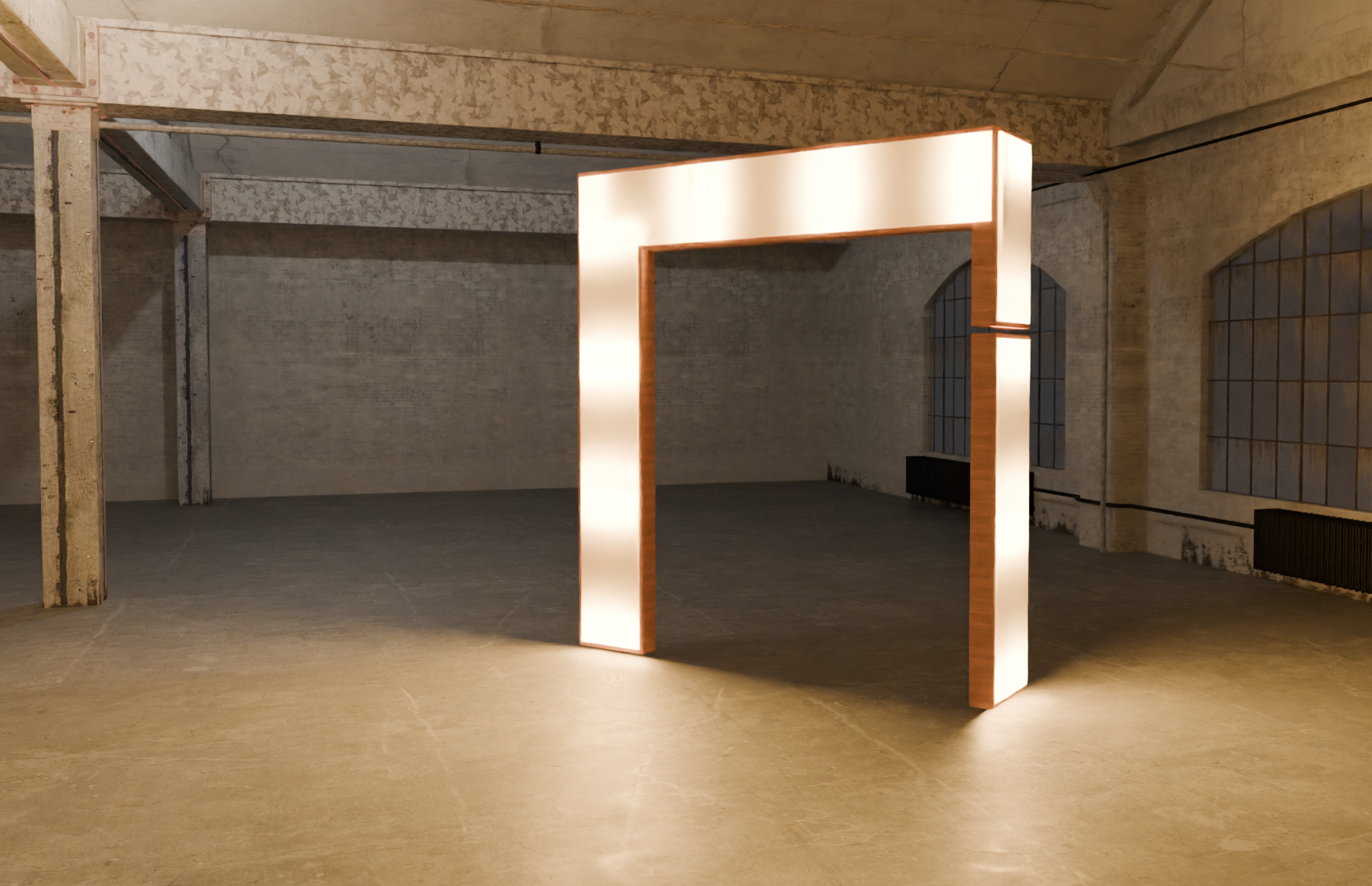
Rendering of a larger-scale Lightbox piece. Perhaps called a Lightform.
With pieces of this scale, situated in public spaces, I can host (and support others in hosting) community events where the piece is an architectural-sculptural centerpiece. Whether it's a café pop-up with tables distributed around the piece, or live performance with the lights as accompaniment, or choreographed dance with the light sculptures, the large-scale pieces can serve as a kind of public art social centerpiece. The variety of possible uses of the sculpture — enabled, in part, by the ease of programming lights for the sculptures using Nuance — opens up possibilities.
Live Performance with AI-Driven Light
The Lightboxes, as large objects of varied shapes and quantity, become performance environments. Working with choreographers and composers, I want to develop pieces where the dance or music is designed in direct relationship with the light — where both sides are shaping each other in real time.
This is a layer where AI is ripe for contribution in the foreground, beyond just providing the tooling in the background. There are rich possibilities here, but to name several options, I'm interested — and have begun prototyping in Nuance — a language-to-light pipeline. There is, moreover, a possibility to extract time-curves for controlling lights from images or videos, further bridging the semantic dominion of existing LLMs into the sensory dominion of light sculpture and accompanying performance.
Imagine, for instance, a performance in which the artist or performer speaks a direction — 'melt down into a puddle on the floor' or 'slow then all at once, like something waking up' — and the light responds. An LLM interprets the language and translates it into Nuance's composition model, producing light that animates the intent. There are more straightforward options too, such as directly translating a dancer's movement into light movement. (In fact, this project originated with building a breath tracker that would control a light with your breath.)
In public spaces, the audience can also use AI: a person walks up to a sculpture, asks for something, and the light changes for them specifically. This can be done iteratively, much like using an AI coding or creative tool: ask for something, change it, add something else, and soon something emerges; you discover something, there's delight. The sculptures become living parts of an environment. I see a world emerging in which digital technology is more omnipresent; I think there's an aesthetic and sociological need to counterbalance that by rolling those digital systems into simpler, emotionally impactful physical structures. Making the digital more material, as it were.
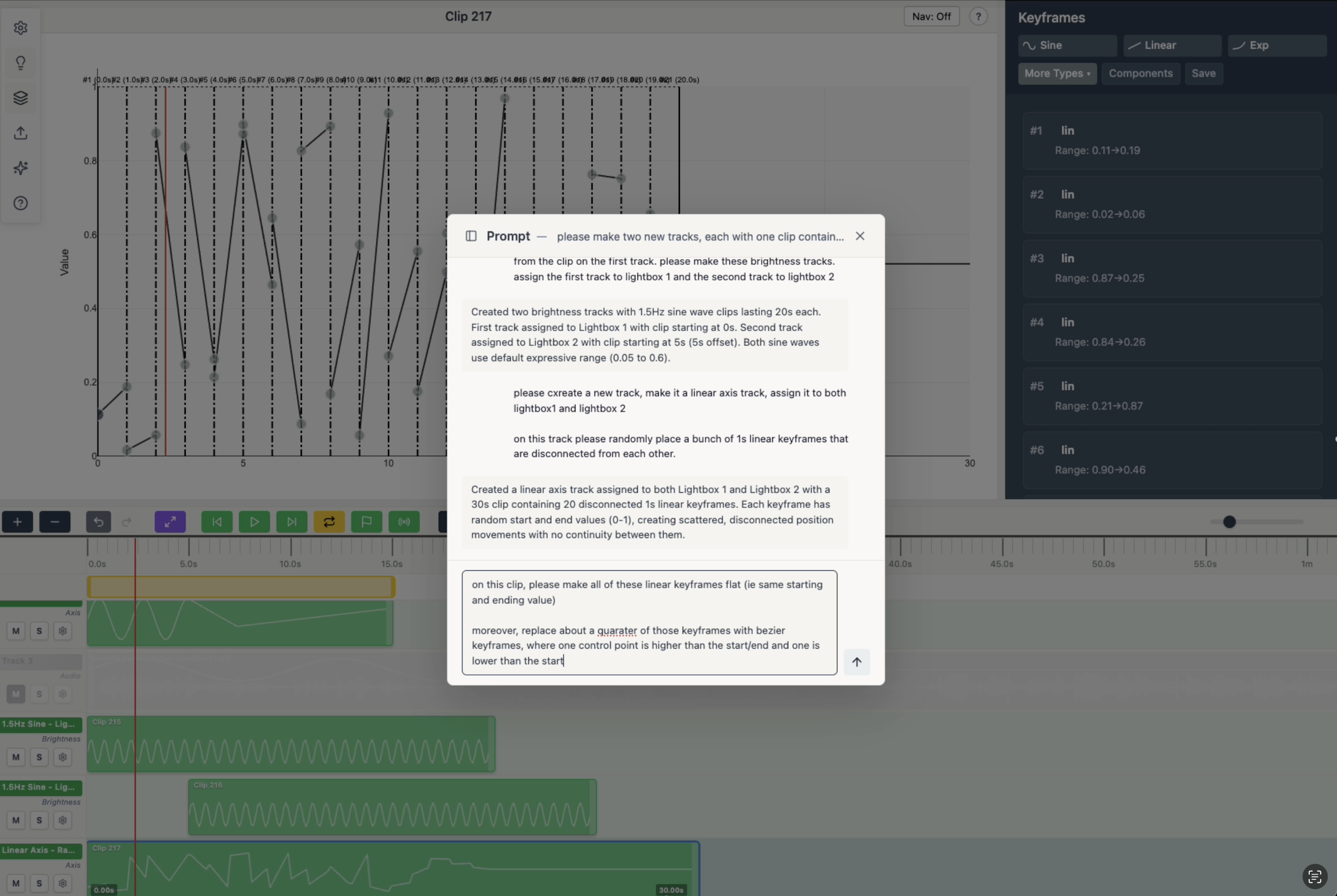
Generating light designs in Nuance with natural language.
Nuance — Live Control Layer
A major part of this project has been developing Nuance, the light design software. I built Nuance entirely using AI tools like Claude Code. The essence of Nuance is making it possible to compose with light with the nuance, and directness, with which we compose music.
Nuance blends shape-native composition (curve design, curve composition, spatial layout of light elements, etc.) with language-native composition (everything in Nuance can be controlled through an LLM interface). Indeed, Nuance builds on ideas I've been cooking on for ten years about the relationship between language and shape/space.
Nuance currently handles composed, pre-programmed sequences. The residency's major software goal is a live performance layer: real-time light control driven by natural language, physical movement, Ableton-like sampling, and more. The language dimension becomes quite interesting as the sculpture size increases, because the more individual LEDs there are, the broader the expressive range. How do you take language and turn it into beautiful compositions, on the fly? How does language interact with gesture, shape, and so on? These questions are interesting unto themselves, and I'd document the approach and what it revealed.
Documentation and Writing
As part of this residency, I will produce a long-form philosophical essay about art, AI, materiality, and culture. This essay would digest my experience working with AI and the Lightboxes and offer a perspective on one particular role of AI in the arts in the coming era. The goal is to publish this essay in a high-visibility outlet, and Anthropic will be acknowledged as the sponsor of the work.
Why Now?
We're at a critical moment in how AI is going to unfold culturally. It's now capable enough to displace jobs; it's enrapturing enough to pull us further into the digital information realm; and we are beginning to realize that society will, in fact, be transformed by it.
It's therefore the necessary moment to double down on physical experiences — the domain of the arts, certain types of entertainment, community — in a way that works harmoniously with the information transformation happening in the digital realm. The Lightbox sculptures are one such exploration; an artwork that is meant to be experienced architecturally, whose existence has been enabled by AI.
For Anthropic
The Work Itself
This residency will yield large-scale finished works, installed, documented, shown publicly. Anthropic can point to them as concrete evidence of AI-enabled creative practice. Moreover, if Anthropic were interested, I would build a piece for one or more of their offices. These works provide a lens into how AI can yield art and space-making that have their own raison d'être independent of AI.
Nuance as a Public Artifact
Nuance — a professional creative tool built by one person using Claude Code and other AI development tools — is an ongoing demonstration of AI-enabled product at a professional level. It's a case-study that Anthropic can point to — one person building a light design tool that can run arenas in under 12 months.
My Writing
I will publish thoughtful, first-person research from inside an AI-enabled creative practice, contributing an introspective voice to a field that, right now, is heavily oriented around the polarities of transcendence and doom.
Structure
Duration
One year, with a review at six months. The first large-scale work alone will take six to eight months from design to installation due to R&D and engineering lead-time.
Independence
Full creative independence. Anthropic can feature completed works and documentation in its own communications, with mutual agreement on how they're framed. The independence is important: it maintains the integrity of the art, and the work (and documentation) can speak more honestly about the role of AI.
Deliverables
- At least two large-scale sculptural works (10–12 ft), installed and documented, during the residency term; one in Paris, one in New York.
- At least one live performance production — dance, music with AI-driven light, or something similar — presented publicly.
- AI live control layer for Nuance, with public documentation of the design approach.
- Ongoing written documentation published under my name, with Anthropic acknowledged as the residency sponsor.
Conclusion
I am proposing an Artist Residency, sponsored by Anthropic, to build a series of monumental-scale light artworks that represent the continuation of the Light and Space, Minimalist, and Modernist traditions into the AI era. This residency would both produce artistic output, as well as first-person research into how AI engages in the arts when the primary medium of the work is physical rather than digital.